NVIDIA–CXMT Twin-Trigger Convergence: A Financing-Risk and Supply-Risk Repricing
Separate NVIDIA’s financing risk from CXMT’s supply threat. Track how both repriced semiconductors simultaneously.

Insights age like wine; news ages like milk.
The evidence below is a timestamp of a recurring cycle.
Observe the mechanism before it repeats.

1. Eternal Logic
This pattern explains how two independent risks lower a sector’s valuation at the same time. A later reversal from confirmed contract-based buying belongs to a separate pattern. The demand exposure occurs when the industry leader supports a customer’s purchase financing. This blurs whether customer demand comes from the customer’s own cash generation or from the supplier’s financial support. Investors price this as a demand quality and sustainability issue. The competitive exposure occurs when a low-cost competitor emerges with secured funding and production technology. Investors price this as a risk that the incumbent’s market share, pricing power, and supply chain advantage will weaken. When the two exposures arrive together, selling pressure extends from the leader to supply chain partners and the sector index.
2. The 2026-07-27 Case Study: Empirical Proof
Background
On Wednesday, July 22 (EDT), Alphabet reported second quarter results after the market closed. Alphabet recorded $44.92 billion in capital expenditure against $39.07 billion in operating cash flow. Free cash flow measures the cash that remains after a company covers its capital expenditure. Alphabet’s free cash flow turned negative for the first time in the company’s history.
On Thursday, July 23 (EDT), Intel reported second quarter results after the market closed. Intel raised its 2026 capital expenditure guidance from $18 billion to more than $20 billion. Intel’s second quarter adjusted free cash flow stood at negative $8.4 billion.
On Friday, July 24 (EDT), Alphabet and Intel had both increased capital expenditure beyond their own cash generation, raising investor doubt over AI infrastructure spending’s sustainability. Intel closed down 7.91% at $92.32. The Philadelphia Semiconductor Index fell 4.25% in the same session, with every constituent lower.
Trigger
On Friday, July 24 (EDT), NVDA announced a letter of intent with SK Group covering more than $500 billion in AI infrastructure cooperation. The preliminary agreement included an AI factory of up to 2 gigawatts for SK Telecom and a long-term high-bandwidth memory supply agreement with SK hynix. High-bandwidth memory is a memory type used inside AI processors.
Separately, on Sunday, July 26 (EDT), a report disclosed that NVDA was in talks to provide approximately $250 billion in financial guarantees for OpenAI’s data center lease.
On Sunday, July 26 (EDT), CXMT began trading on Shanghai’s STAR Market. China’s largest DRAM manufacturer priced its IPO at 8.66 yuan per share and opened at 49.88 yuan, a gain of approximately 476%. Some reports cited an opening gain of about 466%.
On Monday, July 27 (EDT), The Information reported that China had begun domestic production of deep ultraviolet lithography equipment. The report named CXMT among the first recipients of the new machines. Deep ultraviolet and extreme ultraviolet lithography systems etch circuit patterns onto silicon wafers during semiconductor manufacturing. A small number of companies currently supply most of the global lithography equipment market.
Transmission and Market Confirmation
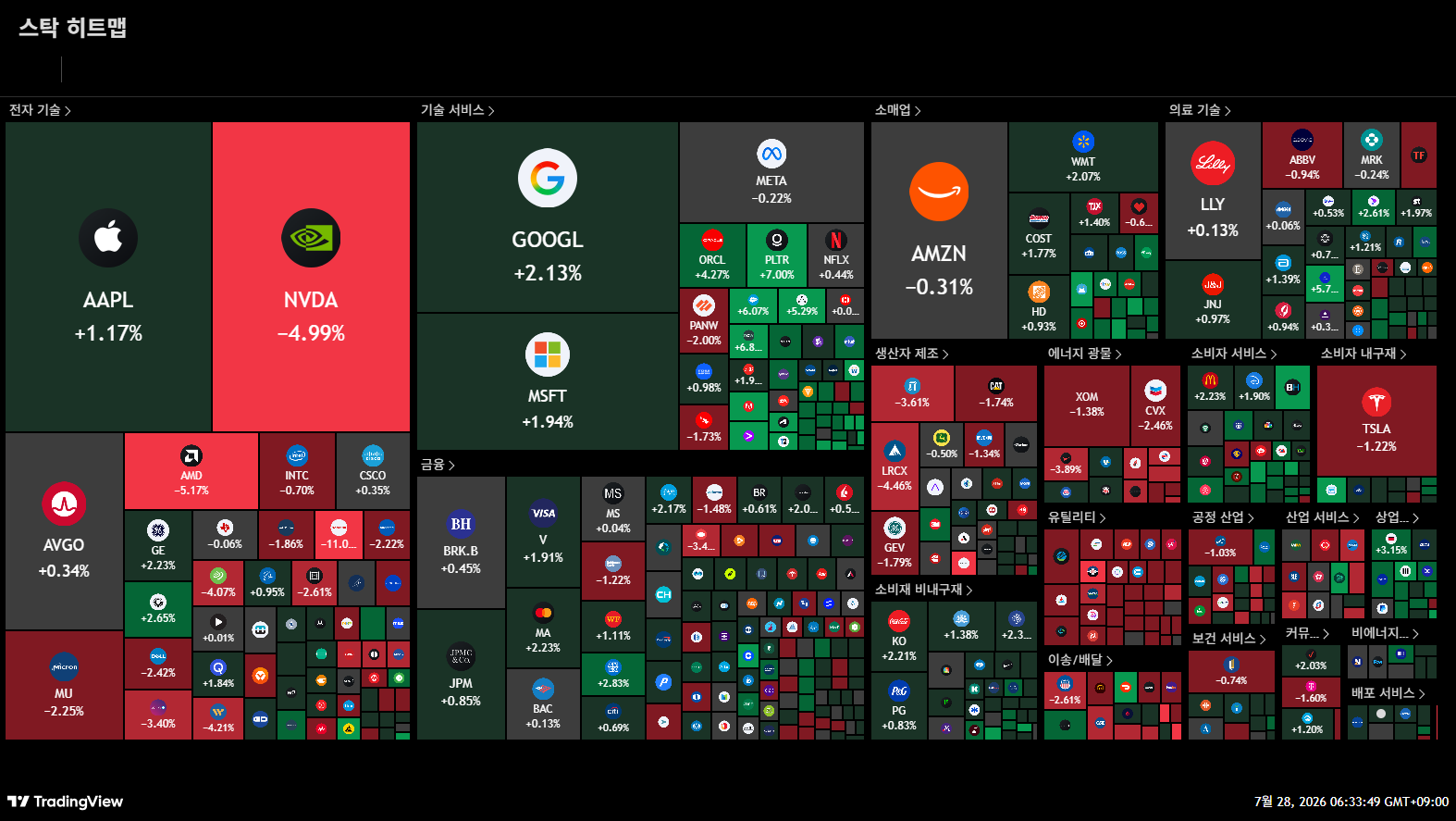
Investors treated the SK Group agreement as confirmation of already-expected investment plans. Market attention shifted to the OpenAI data center financial guarantee. If NVDA guarantees financing for a customer purchasing its own chips, part of that demand could depend on NVDA’s own financial support. Circular financing is a structure where a supplier funds or guarantees a customer’s purchases. This structure can blur the boundary between independent customer demand and supplier-supported revenue. Investors reassessed the quality of NVDA’s revenue and the sustainability of AI infrastructure demand. NVDA closed down 4.99%.
NVDA’s stock decline moved it out of the largest market capitalization position. Apple reclaimed that position on a closing basis for the first time in approximately 15 months.
The selling pressure extended to NVDA’s supply chain partners. SK hynix’s American depositary receipt closed down 7.47% at $143.02. That price fell below the $149 offering price for the first time since the receipt’s Nasdaq listing on July 10. Investors connected concerns about NVDA’s demand sustainability to earnings risk for its major high-bandwidth memory supplier.
The same concern appeared in the credit market. A credit default swap provides protection against a company’s default. NVDA’s 5 year credit default swap premium rose as much as 14bp intraday, reaching 82bp. That was the largest intraday increase since credit default swap trading on NVDA began in November 2025. The equity market lowered NVDA’s valuation. The credit market applied a higher risk premium to NVDA’s financial burden. Both markets reflected the same risk through different pricing paths.
CXMT’s listing and the report of domestic Chinese lithography equipment production raised the likelihood of expanded Chinese semiconductor supply capacity. Through its listing, CXMT gained access to funding for production facilities and technology development. If China also produces lithography equipment domestically, Chinese semiconductor companies can reduce their dependence on foreign equipment suppliers. Securing both production funding and key equipment together could expand China’s memory production volume and technological competitiveness. This led to concern that United States and European semiconductor companies’ market share, pricing power, and equipment supply advantage could weaken.
The two events priced different risks into United States semiconductor stocks. The OpenAI financial guarantee created concern that NVDA could financially support a customer’s chip purchases. This blurred the distinction between real customer demand and NVDA-supported demand. CXMT’s fundraising and China’s domestic lithography equipment production raised the likelihood of expanded Chinese memory supply and reduced dependence on foreign equipment. This could place a long-term burden on incumbent semiconductor companies’ sales volume, pricing power, and equipment revenue. Investors sold United States semiconductor stocks.
Outcome
Index returns diverged by semiconductor weighting. The Philadelphia Semiconductor Index fell 2.23% for a third consecutive session, its lowest level in two months. The Nasdaq Composite fell 0.18%, its fourth consecutive decline. By contrast, the S&P 500 rose 0.02%, and the Dow Jones Industrial Average rose 0.51%. Today’s selling pressure appeared strongly in indices with high semiconductor weighting and did not reach the broader market. The market evaluated this event not as a macroeconomic shock but as a risk internal to the semiconductor sector.
Cross-Market Comparison: Korean Session
Korea’s trading session preceded New York’s by 7 hours.
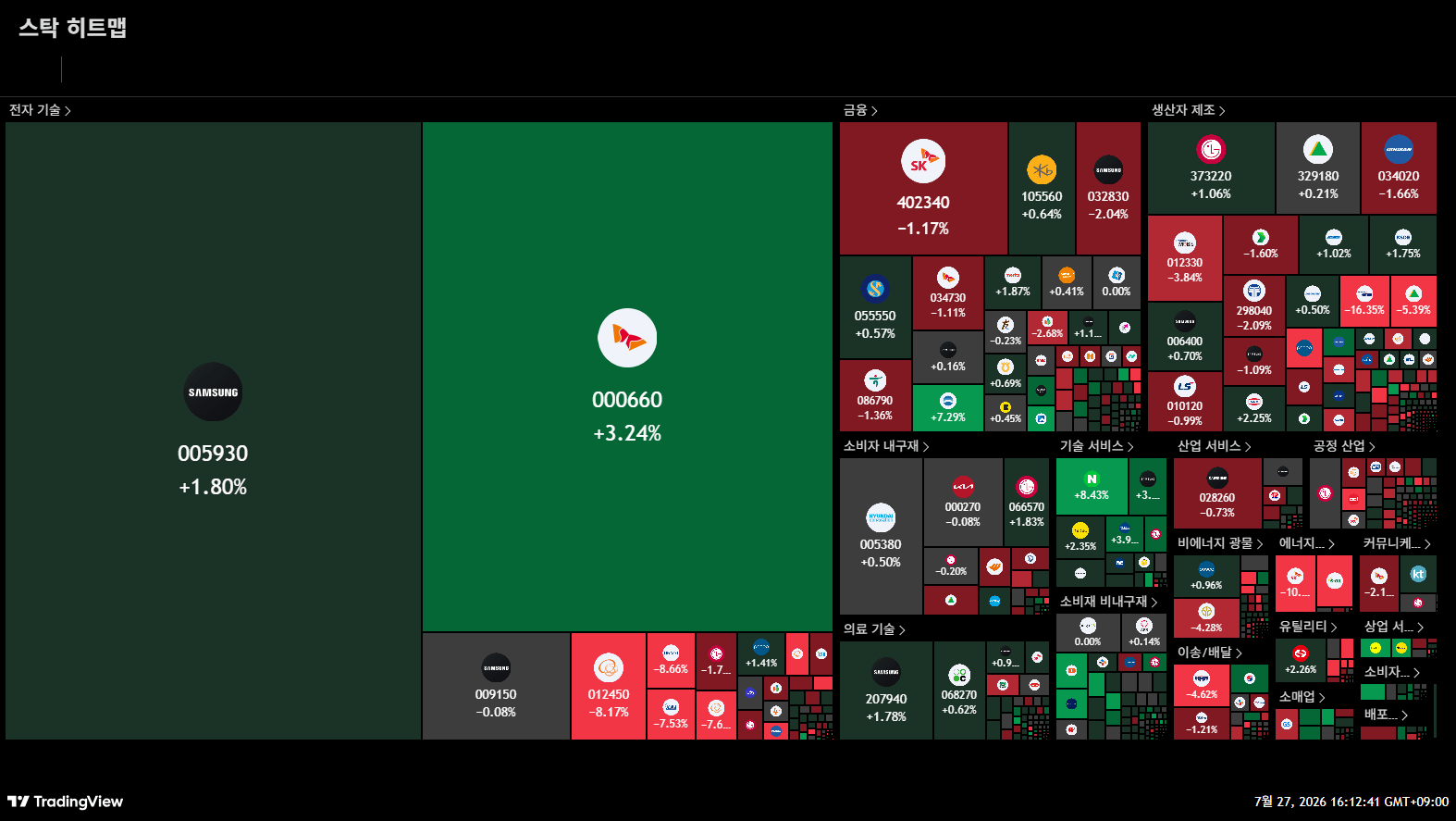
On Monday, July 27 (KST), the CXMT listing reached Korean trading first. CXMT plans to begin mass production of commodity DRAM in the first half of 2027, which could lead to increased global memory supply. Increased future supply could lower commodity DRAM prices. Lower prices could reduce future earnings at memory producers, including SK hynix and Samsung Electronics. Foreign investors sold a net 2.90 trillion KRW of KOSPI shares during the morning session. Net selling included 1.10 trillion KRW of SK hynix and 836.9 billion KRW of Samsung Electronics, together accounting for 67.0% of total foreign selling. KOSPI fell to an intraday low of 6,557.39.
During the afternoon session, the pricing basis shifted from China’s supply expansion risk to the AI infrastructure agreements announced at the San Francisco summit. The SK Group and NVDA letter of intent specified customers, investment amounts, and production categories. Investors treated this as a signal of durable demand for Korean memory companies. Institutional investors bought a net 858.8 billion KRW of KOSPI shares, including 410.8 billion KRW of SK hynix and 125.1 billion KRW of Samsung Electronics. Individual investors bought a net 1.98 trillion KRW of KOSPI shares, concentrated in 702.5 billion KRW of Samsung Electronics and 663.8 billion KRW of SK hynix. That buying reversed the morning decline. SK hynix closed up 3.24% at 71,530 KRW. Samsung Electronics closed up 1.80% at 58,555 KRW. KOSPI closed up 0.97% at 6,755.75.
Seoul and New York priced different disclosures from the same period. Seoul treated the NVDA-SK Group investment and supply agreement announced on Friday, July 24 (EDT) as a signal of Korean memory demand. New York treated NVDA’s potential OpenAI financial guarantee, disclosed on Sunday, July 26 (EDT), as a risk to the independence and sustainability of AI demand. Each market selected a different NVDA disclosure as its primary pricing basis.
3. The Structural Filter: Identifying the Mechanism Across Cycles
The size of the guarantee the leader bears sets the repricing’s magnitude. Confirmed funding and equipment behind the competitor’s claim sets magnitude as well. The timing of the two risks’ arrival also sets magnitude. A guarantee that leaves a substantial burden on the leader’s financial statements lowers the market’s assessment of customer demand’s independence. Secured production funding and key equipment behind the competitor prompt the market to price in a stronger likelihood of future supply increases. Two risks that arrive within the same trading window produce a more confident and intense price reaction. That confidence rises further when share price, supply chain partners, and the sector index move in the same direction. A guarantee that creates no financial burden weakens the basis for a demand exposure repricing. Competitor funding that remains unconfirmed weakens the basis as well. Multiple sectors and major indices declining together reflects a broader macroeconomic shock.
This content is for informational and educational purposes only and does not constitute financial, investment, tax, or legal advice. Past performance is not indicative of future results. All investments involve risk, including possible loss of principal. Consult a qualified advisor before investing. Author may hold positions in discussed securities.
If this research helps you read the market, consider subscribing.
Your support helps me keep doing this work.
[Pre-Market Audit]
Pre-market thesis below.

Separating the financing risk from the supply risk is the useful move here, and the credit-spread detail is the part most write-ups leave out. The vendor-financing half has a settled precedent. Lucent's own filings put customer credit commitments at about 5.7 billion dollars as of 31 December 2000, and the company took 2.2 billion dollars of bad-debt provisions in 2001 as those customers failed. If the shape repeats, the repricing lands in the guarantor's balance sheet before it lands in the chip price. Which line would you watch to see it arrive first?
— Nazem