Alphabet–Intel CapEx Compression: A Hyperscaler-to-Semiconductor Repricing Chain
Track cash sustainability. Reprice suppliers by dependence on future hyperscaler orders.


1. Eternal Logic
In a technology infrastructure cycle, hyperscalers fund data centers and equipment first. Semiconductor and equipment suppliers recognize that spending as orders and revenue. When hyperscaler free cash flow turns negative, existing purchase commitments support confirmed demand for suppliers. When hyperscaler capital expenditure continues to exceed cash generation, the market shifts from evaluating current orders to evaluating whether new orders will continue. When demand-side CapEx expansion alone is the signal, the market reads it as rising order volume for suppliers. When supply-side actors also expand capital expenditure beyond their cash generation simultaneously, the signal changes. AI infrastructure costs are rising on both sides of the trade. The signal covers both the demand side and the supply side. The market then prices in the probability that a slowdown in hyperscaler investment will reduce forward orders and earnings for suppliers. Repricing follows hyperscaler order dependency. Equipment makers reprice before chip producers because capital expenditure changes reach equipment order books before they reach chip shipment volumes. The actor supplying computational output is the exception. Its revenue connects directly to actual workload demand on existing infrastructure.
2. The 2026-07-24 Case Study: Empirical Proof
Background
Alphabet released Q2 results after the July 22 (EDT) close. The release shifted how the market evaluates AI hyperscalers, from revenue growth to free cash flow generation. Free cash flow turns negative when capital expenditure exceeds operating cash flow, removing the earnings basis for premium growth multiples. Platform companies spend on AI infrastructure before it generates revenue, so capital expenditure runs ahead of operating cash flow. Alphabet fell 7.13%. Amazon fell 4.57%. Meta fell 3.36%. Microsoft fell 2.24%. Purchase commitments are contractually obligated future payments representing confirmed forward order flow to memory and equipment suppliers. Semiconductor suppliers rose on Alphabet’s 811.0 billion USD in purchase commitments. Micron rose 2.97%. SK hynix’s US-listed depositary receipt rose 2.56%. KLA rose 1.88%. Applied Materials rose 1.61%.
Separately, at 06:37 (EDT) on July 23, Houthi forces attacked Saudi oil tankers in the Bab el-Mandeb Strait. The attack extended oil supply disruption risk beyond the Strait of Hormuz for the first time in this conflict. WTI crude rose 6.17% to 92.19 USD. Brent crude rose 7.04% to 100.69 USD. Rising oil prices pushed inflation expectations higher and lifted the 10-year Treasury yield above 4.70% intraday. Higher yields increased the discount rate applied to future earnings. Platform companies already repricing on FCF compression faced additional valuation pressure from the yield move.
SOX fell 0.54%. The Nasdaq Composite fell 2.15%. The S&P 500 fell 1.21%. The Dow Jones Industrial Average fell 0.97%.
Trigger
July 22 (EDT), after the close. Alphabet reported Q2 results. Capital expenditures of 44.92 billion USD exceeded operating cash flow of 39.069 billion USD. Free cash flow turned negative for the first time in the company’s history. Alphabet raised its full-year 2026 capital expenditure guidance to a midpoint of 200 billion USD. Purchase commitments rose from 332.4 billion USD at the end of Q1 to 811.0 billion USD at the end of Q2. Alphabet fell 5% in after-hours trading.
July 23 (EDT), after the close. Intel reported Q2 results. Non-GAAP earnings per share reached 0.42 USD, twice the consensus estimate of 0.21 USD. Q2 operating cash flow reached 7.0 billion USD. Adjusted free cash flow was negative 8.4 billion USD. Intel disclosed 2026 capital expenditures rising from 18 billion USD to above 20 billion USD. Intel also guided that 2027 capital expenditure would rise meaningfully above 2026. Shares jumped approximately 12% in after-hours trading to around 112 USD. Shares gave back the full advance and fell below the July 23 regular-session close of 100.23 USD before the July 24 open.
Transmission and Market Confirmation
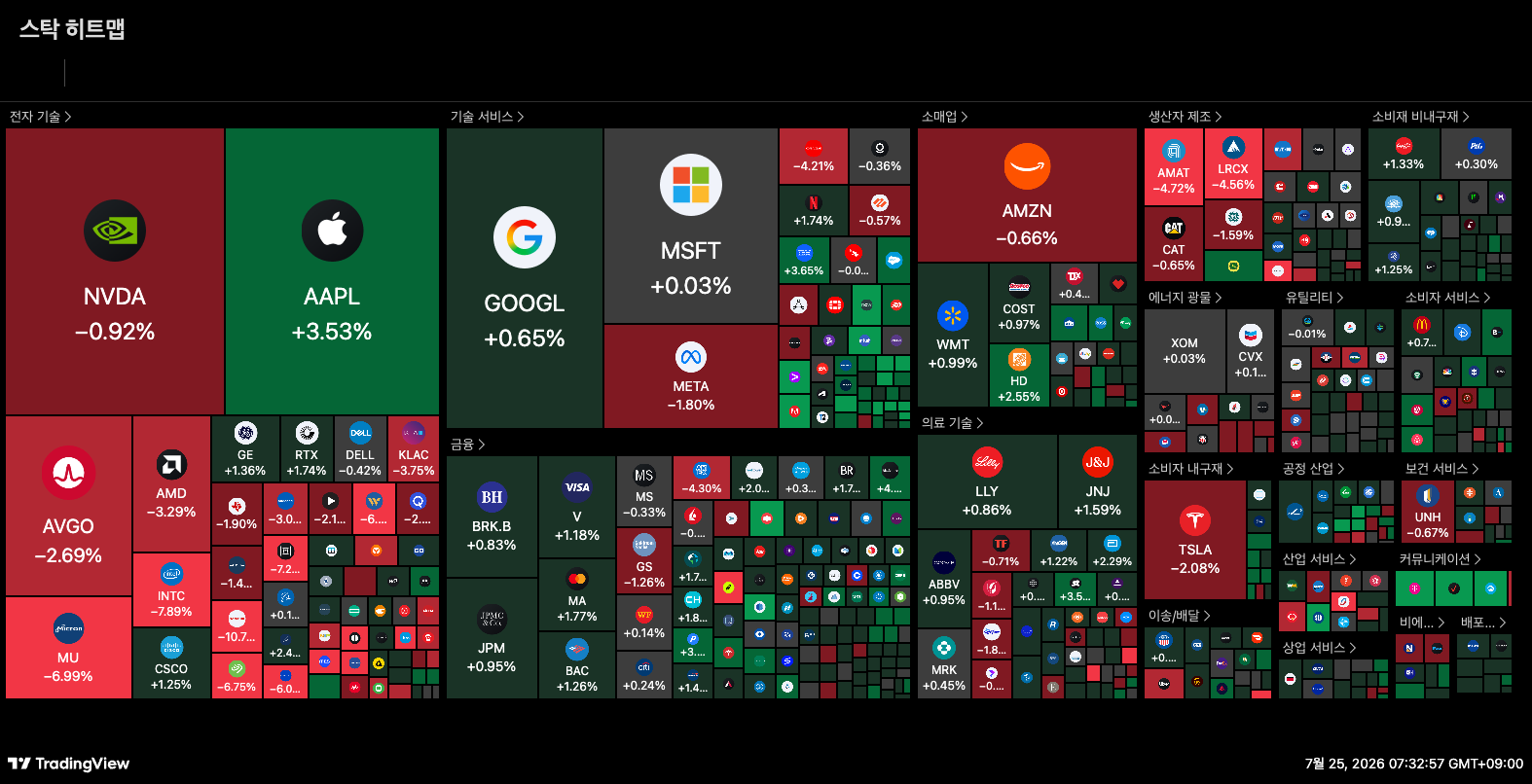
Intel reported earnings per share at twice the consensus estimate. Intel shares jumped approximately 12% in after-hours trading. Intel then disclosed capital expenditures rising from 18 billion USD to above 20 billion USD. Intel shares fell on that disclosure. The decline continued into the regular session. Intel closed July 24 (EDT) down 7.91% at 92.32 USD.
On July 23 (EDT), after Alphabet’s Q2 results, the market priced semiconductor suppliers on confirmed forward demand. Alphabet’s 811.0 billion USD in purchase commitments represented contractually confirmed orders to memory and equipment suppliers. Those orders remained valid regardless of Alphabet’s own free cash flow position. Memory suppliers and semiconductor equipment makers rose between 1.61% and 2.97% on that basis.
Yet, Intel’s capital expenditure disclosure changed how the market evaluated AI infrastructure investment. On July 23 (EDT), Alphabet’s capex expansion had been read as confirmed demand for semiconductor and equipment suppliers. Alphabet’s 811.0 billion USD in purchase commitments reinforced that reading. Alphabet is the demand side of the AI infrastructure trade. Alphabet’s spending flows directly to chip suppliers as purchase orders. However, Alphabet’s capital expenditure exceeded its operating cash flow, turning free cash flow negative. The market began evaluating current orders and the sustainability of future investment. On July 23 (EDT), Intel then disclosed its own capex expansion. Intel is the supply side of the AI infrastructure trade. Alphabet, the demand side of the AI infrastructure trade, and Intel, the supply side, were both spending beyond their cash generation. Alphabet’s capital expenditure of 44.92 billion USD exceeded its operating cash flow of 39.069 billion USD. Free cash flow turned negative for the first time in Alphabet’s history. Intel’s Q2 adjusted free cash flow was negative 8.4 billion USD against 2026 capital expenditure guidance of above 20 billion USD. Semiconductor suppliers depend on hyperscaler capital expenditure for their purchase orders, making the sustainability of that capital expenditure the new risk. Semiconductor supplier valuations fell on that uncertainty.
Hyperscaler capital expenditure funds the purchase orders that memory and chip suppliers receive. Alphabet’s and Intel’s capital expenditure carries a sustainability question. Both are spending beyond their cash generation. The forward order flow of those suppliers carries the same uncertainty. Companies that supply memory and processing capacity directly to hyperscaler data centers faced the primary repricing.
ARM licenses CPU and AI chip architectures to hyperscaler data centers and collects royalty revenue on each chip deployed. A slowdown in hyperscaler capex reduces the chips ARM earns royalties on. ARM carried a year-to-date gain of approximately 179% and the highest valuation premium among SOX components entering July 24. ARM fell 8.23%. Micron supplies high-bandwidth memory, or HBM, a stacked DRAM architecture inside AI accelerators and Micron’s highest-margin product line. A slowdown in hyperscaler AI infrastructure investment reduces HBM order volumes. Micron fell 6.99%. AMD supplies AI accelerators to hyperscaler data centers through its MI300X product line. AMD’s revenue depends directly on hyperscaler AI infrastructure purchases. AMD fell 3.27%. Broadcom supplies custom AI accelerators and networking chips to hyperscaler data centers. Broadcom manufactures chips that hyperscalers design themselves. A slowdown in hyperscaler AI infrastructure capex reduces Broadcom’s custom chip orders. Broadcom fell 2.69%.
Hyperscaler capital expenditure changes reach equipment order books before they reach chip shipment volumes. Equipment orders are placed months to years before production begins. A sustainability question in hyperscaler capital expenditure reaches semiconductor equipment makers before it reaches chip producers. Semiconductor equipment makers repriced on that sequence.
Applied Materials supplies the deposition and etch tools required to fabricate advanced memory. A reduction in hyperscaler AI infrastructure investment would reduce the volume of advanced memory fabricated and reduce Applied Materials equipment orders. Applied Materials fell 4.72%. KLA supplies process control equipment that inspects and verifies each step of the advanced memory fabrication process. Fewer advanced memory wafers in production would reduce demand for KLA inspection and metrology systems. KLA fell 3.60%. ASML manufactures EUV lithography systems under a global production monopoly. ASML equipment lead times extend the horizon over which hyperscaler capex changes reach its order book. ASML fell 2.53%.
The repricing extended to the physical layer of data center construction. Hyperscaler capital expenditure funds the data centers being built. A reduction in that capital expenditure reduces the volume of data centers under construction. Fewer data centers under construction reduce the demand for the power and cooling systems those facilities require.
Vertiv supplies power management and cooling systems for AI data centers. Fewer data centers under construction would reduce demand for Vertiv power and cooling equipment. Vertiv fell 4.48%. Quanta Services builds the electrical infrastructure that connects data centers to the power grid. Fewer data centers under construction would reduce Quanta Services electrical infrastructure contracts. Quanta Services fell 4.27%. Eaton supplies the power distribution systems installed inside data centers. Fewer data centers under construction would reduce Eaton power distribution equipment orders. Eaton fell 2.66%.
In contrast, Nvidia supplies the GPU computing capacity that hyperscalers use to execute AI workloads. AI workload execution requires GPU deployment regardless of any individual hyperscaler’s capital expenditure trajectory. Nvidia fell 0.92%. ARM, the most hyperscaler-dependent component in the repriced group, fell 8.23%. The 7.31pp spread between ARM and Nvidia quantified the repricing boundary. ARM was priced on hyperscaler capital expenditure expansion. Nvidia was priced on AI workload execution demand.
Separately, during the morning session on July 24 (EDT), Pakistan’s reported mediation effort between the United States and Iran reduced oil supply disruption risk. Houthi forces confirmed their blockade targeted Saudi Arabia only, leaving the Bab el-Mandeb partially open. WTI closed at 89.31 USD, down 3.12%. The 10-year Treasury yield fell 2.4bp to 4.679%. Oil prices and government bond yields both fell on July 24. Lower oil prices and lower yields reduce the discount rate applied to future earnings, supporting equity valuations.
Capital moved out of AI infrastructure-dependent positions and into companies generating current free cash flow outside the AI infrastructure cycle. The technology sector fell 0.88%. The materials sector rose 1.44%. Real estate rose 2.36%.
Outcome
SOX closed down 4.25% on July 24 (EDT) with all components lower. The Nasdaq Composite fell 0.64%. The S&P 500 rose 0.05%. The Dow Jones Industrial Average rose 0.46%.
VIX closed at 18.58, down 0.64%. MOVE closed at 76.82, down 4.07%. SOX fell 4.25% in the same session. The broad indices and volatility measures held steady while the semiconductor sector fell sharply. Capital stayed in equities and moved from AI infrastructure-dependent positions into positions priced on current earnings and cash flow.
Cross-Market Comparison: Korean Session
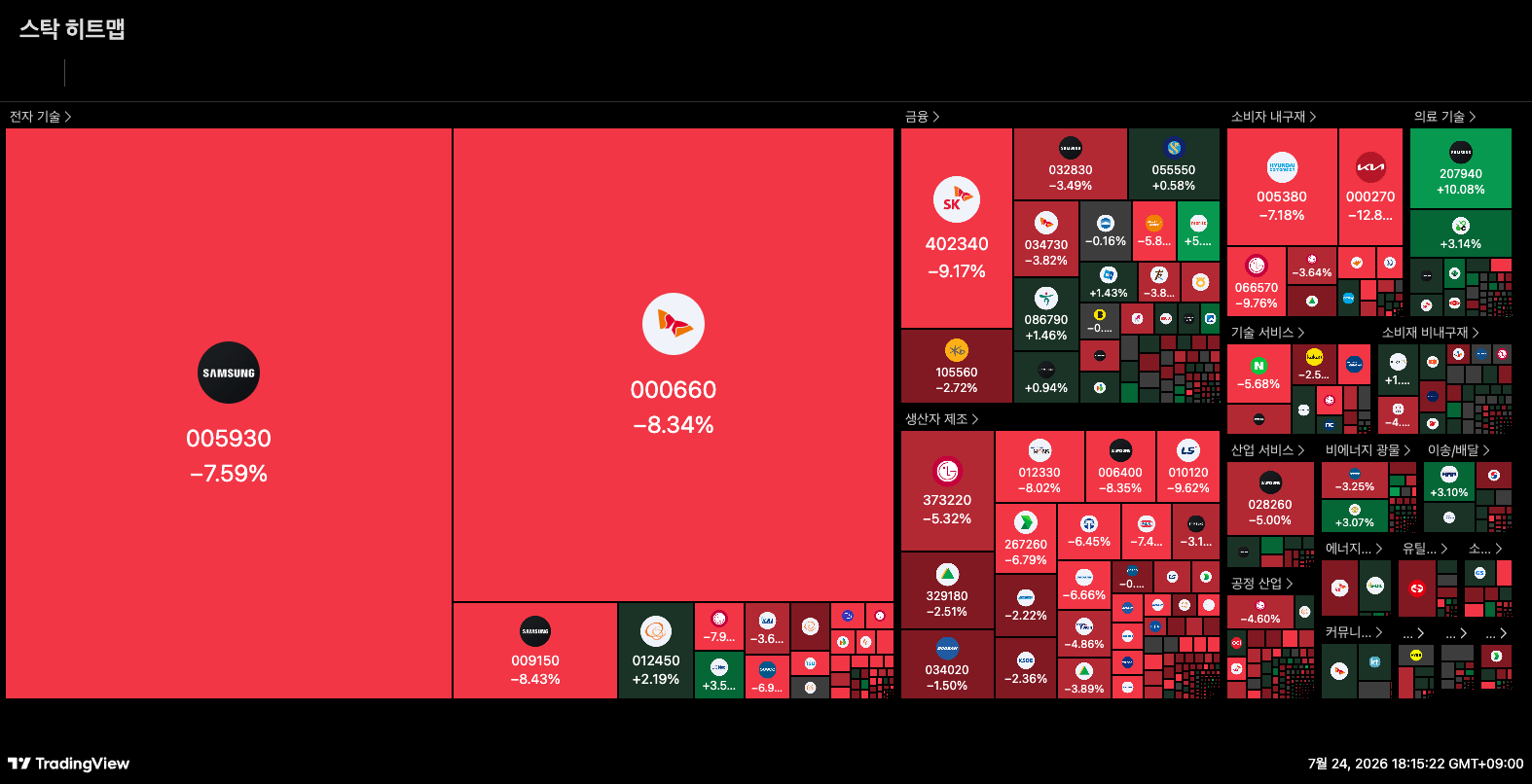
KOSPI opened July 24 (KST) at 7,000.78, down 1.35% from the prior close of 7,096.89. Intel had reported after the US close and fallen in after-hours trading before the Korean session opened. KOSPI fell from the open. SK hynix and Samsung Electronics fell the most in the opening session.
At 09:43 KST, Iran formally rejected a US ceasefire proposal. Iran’s rejection placed both the Strait of Hormuz and the Bab el-Mandeb Strait under simultaneous supply disruption risk. Brent crude rose 6.62% to 100.69 USD. The Korean 10-year government bond yield rose 6.2bp to 4.449%. Higher yields raise the discount rate applied to future earnings, adding downward pressure to equity valuations. Semiconductor stocks had priced in future earnings from long-term AI infrastructure investment and fell further on the yield increase.
Foreign institutional investors net sold 3.28 trillion KRW of KOSPI stocks. SK hynix accounted for 1.76 trillion KRW and Samsung Electronics accounted for 873.1 billion KRW. SK hynix and Samsung Electronics together represented 80.1% of total foreign net selling.
Institutional investors net sold 1.95 trillion KRW of KOSPI stocks. SK hynix accounted for 577.8 billion KRW and Samsung Electronics accounted for 804.7 billion KRW. SK hynix and Samsung Electronics together represented 70.9% of total institutional net selling.
SK hynix fell 8.34%. Samsung Electronics fell 7.59%. KOSPI fell 5.72% to 6,690.62.
3. The Structural Filter: Identifying the Mechanism Across Cycles
Repricing is stronger when both CapEx-over-earnings confirmations arrive within a short time window. Supply-side actors with higher valuation premiums fall further when the second confirmation arrives. The mechanism loses force when supply-side CapEx expansion is contractually tied to demand-side purchase guarantees, because that linkage converts CapEx expansion into confirmed demand. The mechanism also loses force when demand-side actors access low-cost capital to offset FCF compression. The structurally distinct case is single-side FCF compression. When only the demand side shows CapEx exceeding cash flow and supply-side actors report positive free cash flow, the market retains the isolation assumption.
This content is for informational and educational purposes only and does not constitute financial, investment, tax, or legal advice. Past performance is not indicative of future results. All investments involve risk, including possible loss of principal. Consult a qualified advisor before investing. Author may hold positions in discussed securities.
If this research helps you read the market, consider subscribing.
Your support helps me keep doing this work.

This is such an eye-opening breakdown of what is actually happening behind the scenes with AI right now.
To a beginner, looking at big names like Alphabet or Intel can feel like trying to read a different language. But your piece points out a universal truth everyday investors need to hear: cash is king. It doesn’t matter how exciting or futuristic a technology like AI is—if a company is spending more money building it than they are actually bringing in, a reality check is inevitable.
For regular people trying to build long-term wealth, this is a perfect lesson in why we can't just get swept up in the hype. We have to look at the foundational math.
Thanks for the clarity.
The institutional research stack is covering the same 20 names with the same price targets right now. A space that surfaces independent work on supply chains and infrastructures is exactly what this ecosystem needs. The Archive/Gallery split is the right way to handle depth vs. signal too